Category: Secret Folklore
⌚ Approximately 10 minutes to read
⚠ Content Warning: medical neglect, death, war, violence, injury
Fans of popular media may already be aware of the Sickly Green Glow trope, which asserts that, “Power glows, but evil power glows green.” We’ve probably all been exposed to this trope at sometime in our lives, whether it’s kryptonite’s emerald glow depriving Superman of his powers, or the sinister green hue of everything in Slytherin’s dorm rooms.
In my case, my first memory of the sickly green glow is when I watched Teenage Mutant Ninja Turtles on television as a child. We lived in the middle of nowhere, so most of the things on TV tended to be black and white and “fuzzy” – for those of you too young to remember, imagine static on a radio station but visual instead of auditory (actually that reference may be dated as well, now that I think about it). Nevertheless, in the brief flashes of color and clarity (if we can say things made before HD technology had clarity), I remember quite clearly the glowing, green toxic sludge that mutated those cute little tortoises into the teenaged mutant superheroes I loved.
Anyway, I’m sure you’re not here to learn about TV from the dark ages (aka the 80s). The point is, I got to thinking about what sorts of real-life events may have inspired this trope. So, without further ado, here are three times people glowed green in real life.
The Green Children of Woolpit
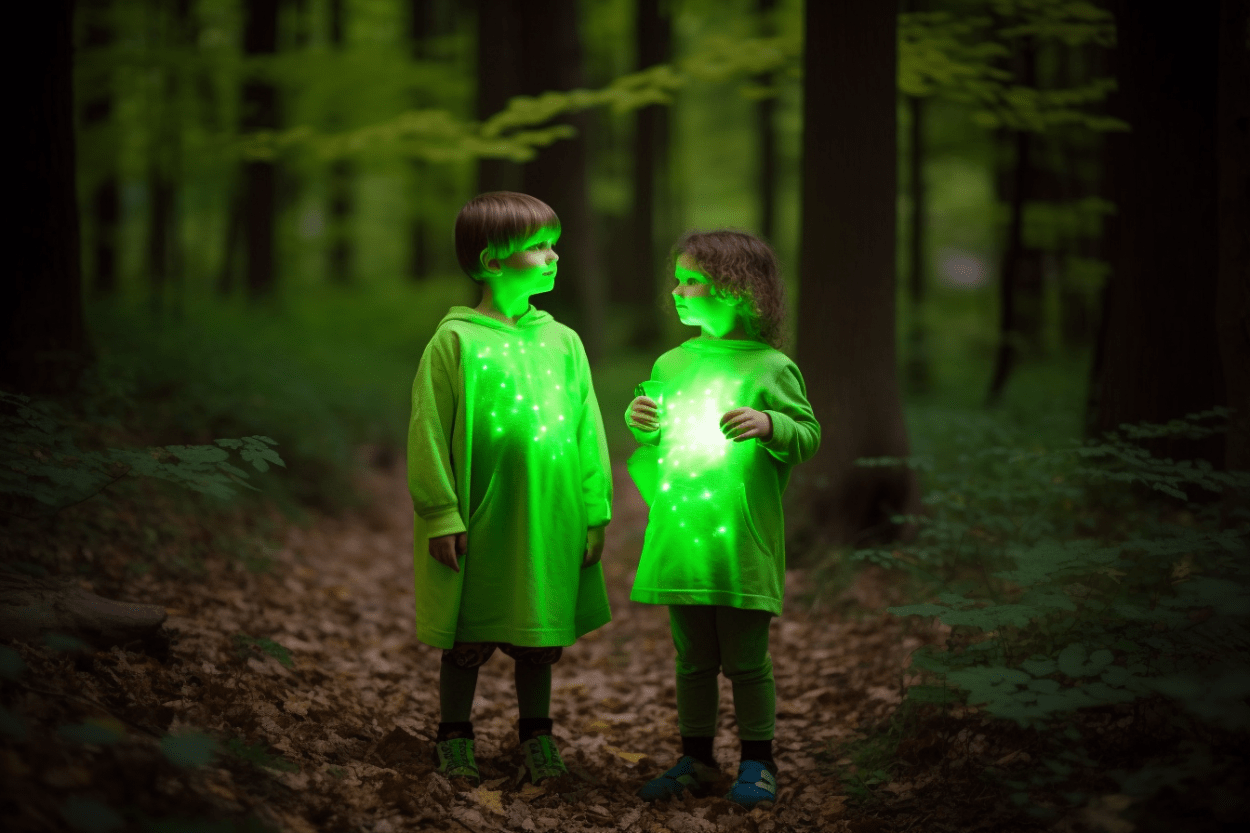
Our first tale of people glowing green concerns two mysterious children who were found in the woods near the village of Woolpit in the 12th century. The children spoke in a language that no one else understood and had a sickly green glow to them.
The story itself survives in two accounts. The first is found in the Chronicon Anglicanum by the abbot from a Cistercian monastery just south of Woolpit, Ralph of Coggeshall. The second is in the Historia rerum Anglicarum by a priest by the name of William of Newburgh who based his accounts on “reports from a number of trustworthy sources.”
The village of Woolpit is named after the large trapping pits (also known as wolf pits) the villagers dug in the surrounding area to trap animals – in this case wolves. It was near one of these pits that the two children in question were found. One harvest day, several villagers were coming to check the traps when they heard the weeping of children.
The girl and her younger brother astonished the villagers with their unfamiliar dress and unintelligible language. Even more curious was the fact that their skin glowed with a green light. Nevertheless, the villagers couldn’t leave two helpless children unattended in the wilds, so they brought them back to town, where a man by the name of Richard de Calne took them into his home.
Over the next few days, Richard and his family attempted to communicate with the children and take care of their needs, but no matter what they offered them, the children refused to eat anything. Fearing that the children would starve, the villagers began to try anything they could think of until finally someone offered them some broad beans (which are similar to peas). The children ate the beans eagerly, motioning for more and more of them, until finally they were full.
Their green color began to disapate as they learned to eat different types of food, until finally they appeared to look like anyone else in the village. As the children began to integrate themselves into society, the villagers decided that they should be baptised. It wasn’t long after that, according to Ralph’s account, that the boy child became ill and passed away.
Eventually, the surviving girl, who came to be called Agnes, learned to speak enough English to explain what had happened and how she and her brother had ended up in Woolpit. According to the girl, she and her brother had lived in a land called Saint Martin’s Land. It was a place with no sun; a land of perpetual twilight. The girl explained that everything in Saint Martin’s Land, from the plants to the people, is green.
As for how the children became spirited away to Woolpit, the girl only said that she and her brother were working on their father’s ranch when they had followed some lost cattle into a cave. From deep within the cave came the sound of bells and, when the children followed the noise, they found themselves transported into a different land.
It is said that the girl grew up and became a servant in the de Calne house, although perhaps a tad willful. After some time, she was married to a man by the name of Richard Barre, a royal official in King’s Lynn.
The Angel’s Glow at the Battle of Shiloh
Let’s jump ahead about 700 years to the year 1862. Almost exactly a year from the start of the American Civil War, the Battle of Shiloh (also known as the Battle of Pittsburg Landing) began on April 6th when Confederate soldiers launched an attack, catching the enemy flatfooted. Overnight, reinforcements arrived for the surprised Union soldiers, who began a counterattack early the next morning.
Needless to say, many soldiers were injured or worse during the battle. In fact, it was the costliest battle of the entire war up to that point. More than 3,000 men lost their lives in the battle and greater than 16,000 were injured.
With all of those injuries, it took quite some time to find and tend to the wounded. Add to that the generally lacking medical care at the time, like the absence of modern things like antibiotics, and you have a recipe for disaster. Soldiers were waiting in the mud and swamps, some of them for days.
On this particular battlefield, however, something strange was happening. As night fell, many injured soldiers found that their wounds had begun to glow a soft green color. As the recovery effort continued, it was noted that those soldiers with glowing wounds seemed to recover at a higher rate than those without, and the term “angel’s glow” was coined for the strange occurence.
Almost 140 years later, in 2001, two high school students are believed to have found the reason for the angel glow. Bill Martin and Jonathan Curtis, with some guidance from Martin’s microbiologist mother, pinpointed the cause as a bioluminescent bacteria called photorhabdus luminescens.
The Ghost Girls of the First World War
During World War I, a group of girls and women were employed to paint watch dials with luminous radium paint. These watches would allow soldiers in the field to tell the time at night without giving away their positions with a larger light source. They would paint the numbers onto watch faces for hours on end, with no protection of any kind, unknowingly exposing themselves to harmful radiation.
These women and girls soon became known as “ghost girls” because they would quite literally glow green after their shifts. Luminous radium paint contains radium, as the name suggests, but also phosphor. The Radium would excite the phosphor, which is what caused the green glow.
The ghost girls weren’t going to let a little extra green light at night stop them, though. In fact, for many, the radium’s luminosity became part of their style. They saw the glow as a kind of perk, making sure to wear their best outfits to work so they’d shine like stars at the dance halls at night. At work, the ghost girls had also been taught to pull their paintbrushes between their lips to make a fine point — a practice called lip-pointing. It wasn’t long before some began to intentionally paint their teeth, creating a glowing smile that almost certainly got a lot of attention at the night clubs.
To those of us who are aware of the horrible effects of radiation poisoning, these practices seem like absolute madness, but at the time, this information was not shared with the women and girls employed in the industry. In fact, according to interviews with some of the ghost girls, they were told outrightby their supervisors that the radium paint couldn’t hurt them.
The supervisors, however, were lying through their non-glowing teeth. Ever since Marie Curie had suffered radiation burns from handling radium, it had been known that radium was definitely not safe to handle, much less to ingest orally. People had even died from radium poisoning before the practice of dial painting had begun. It was for this reason that the men who worked with the radium wore lead aprons in their laboratories and used ivory-tipped tongs to handle the radium. Yet the dial painters were not offered any protection.
It wasn’t long before the ghost girls started experiencing side effects from their shifts and, in 1922, Mollie Maggia, one of the girls who had been painting her smile, had to quit because of the effects of radium poisoning. What started out as an aching tooth quickly turned into all of her teeth being extracted. In their place agonizing ulcers appeared. She also began to struggle with aching pains in her limbs that became so debilitating that she was eventually unable to walk. It wasn’t long before Mollie had to have her entire jaw removed.
In less than a year, the radium poisoning had taken Mollie’s life, and many others’, as well. Those who survived began the uphill battle for many of the worker’s rights we enjoy today. Unfortunately, and not surprisingly, it wasn’t until a man at one of these companies was affected by the radium that their plight was taken seriously.
After a long and arduous legal battle in several cities, uncovering numerous cover-ups, the ghost girls – or at least those who had lived long enough – finally won. The case was the first in US history in which an employer was held as responsible for the health and wellbeing of their employees and led to the establishment of the Occupational Safety and Health Administration (OSHA).
Conclusion
So, what do you think? Did any of these stories of sickly green glowing contribute to the tropes so prevelant in modern sci fi and fantasy media? Perhaps all of them did.
Did I leave out any important secret folklore? Tell me in the comments!
Further Reading
The Sickly Green Glow Trope: TVTropes page on the sickly green glow
The Chronicon Anglicanum: contains Ralph of Coggeshall’s account of the Green Children of Woolpit (Latin)
Historia rerum Anglicanum: contains William of Newburgh’s account of the Green Children of Woolpit (Latin)
The Green Child: a story written by Herbert Read based on the Green Children of Woolpit story
Photorhabdus Luminescens: the Wikipedia article about the green glowing bacteria Photorhabdus Luminescens
Radium Girls: the Wikipedia article about the ghost girls (aka radium girls)
 Aetherloft