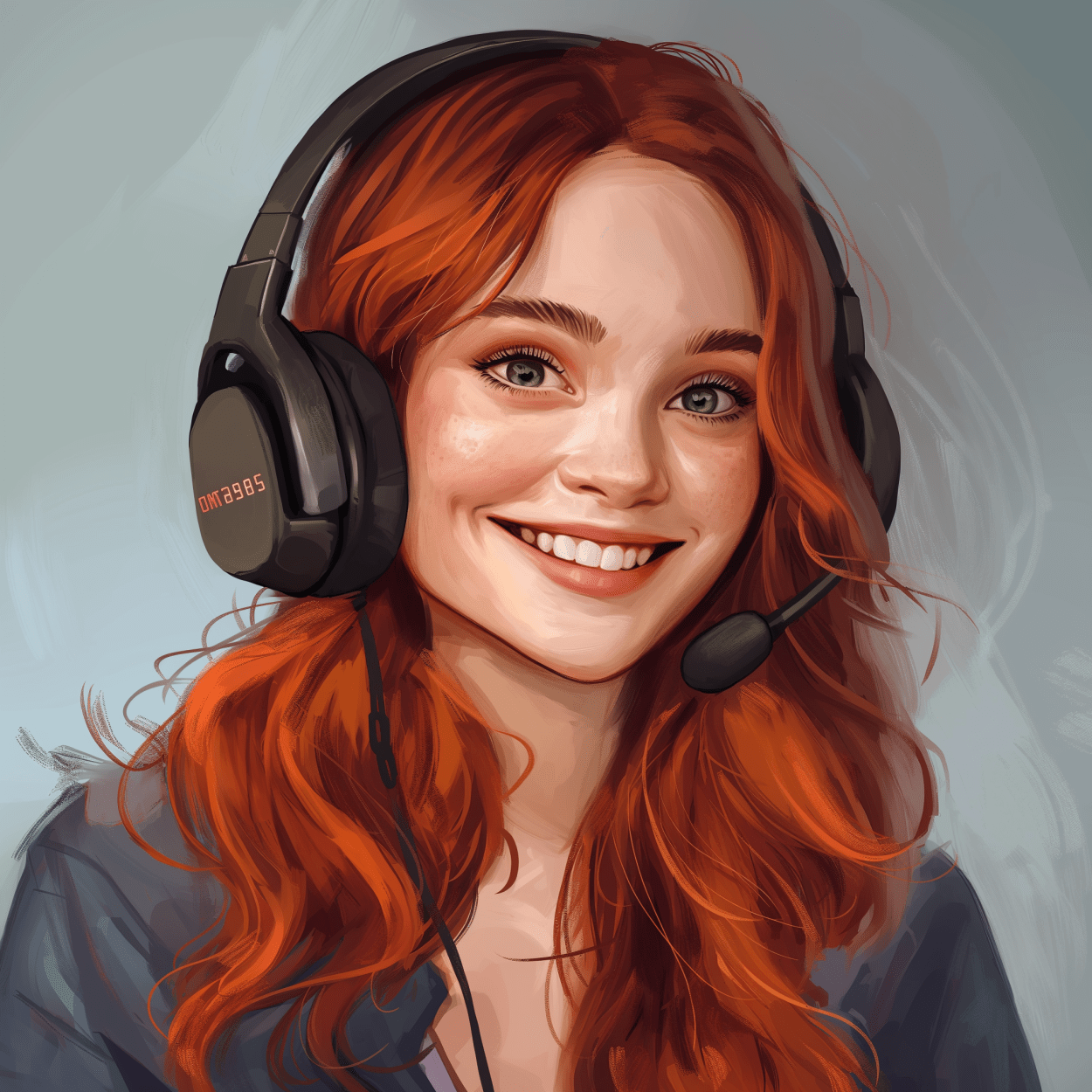
Anchor: Good evening, and welcome to tonight’s edition of Global News Network. I’m your host, Sarah Williams. Our top story tonight: the rising concern over AI-generated avatars, known widely as simulants, on the popular cam-site, VirtuaCam. Recent reports suggest that an increasing number of users are abandoning the platform, feeling deceived by artificial performers posing as real individuals. Our correspondent, James Parker, has the details.
The scene cuts to James Parker in a most likely green-screened newsroom.
James Parker: Thank you, Sarah. VirtuaCam, once hailed as a leading platform for live-streamed entertainment, is now facing a significant crisis. Users are growing wary of the authenticity of the cam-artists they interact with, suspecting that many may be AI-generated avatars. This suspicion has led to a wave of users leaving the site, feeling misled and scammed. Let’s take a closer look at the issue.
Footage of the VirtuaCam interface and user interactions plays in a loop while James continues to speak in voiceover.
James Parker: VirtuaCam has long been a favorite among users seeking live, interactive experiences with performers from around the world. However, the site’s success has come under scrutiny as advanced AI technology has made it increasingly difficult to distinguish between human and artificial performers.
The footages cuts to an interview with a former VirtuaCam user, John Smith (that can’t be his real name).
James Parker (off-camera): Joining us now is John Smith, a former VirtuaCam user. John, thank you for speaking with us. Can you tell us about your experience?
John Smith: Absolutely. I used VirtuaCam for about a year and really enjoyed the interactions. But over time, I started noticing that some performers seemed too perfect. Their responses were almost robotic, and there were occasional glitches that made me question if they were real. It felt like a betrayal when I realized they might be simulants.
James Parker (off-camera): How did this realization affect your use of the platform?
John Smith: I felt deceived. I was paying for authentic interactions, and instead, I was interacting with sophisticated algorithms. I decided to leave the platform and found many others in the community felt the same way.
The scene cuts back to James Parker in the (fake) newsroom.
James Parker: John’s experience is not unique. Reports indicate a significant decline in VirtuaCam’s user base, with many citing similar concerns. The company has acknowledged the issue and is now facing the challenge of restoring trust.
Rebecca Morgan, my boss and VirtuaCam’s spokesperson appears on the screen via video conference. My shoulder is almost visible off to one side of her.
Rebecca Morgan: At VirtuaCam, we take these concerns very seriously. My chief security moderator here, Alex Turner, and I are implementing stricter verification processes in order to ensure the authenticity of our performers. Our goal is to provide a safe and genuine experience for all our users.
The camera zooms out slightly, showing the rest of my shoulder and half of my face before cutting back to James in the newsroom. I couldn’t believe they cut me out of the interview almost entirely, only showing one side of my face. It wasn’t even my good side!
James Parker: Despite these assurances, the damage may already be done. Industry experts warn that the rise of AI-generated content poses a significant challenge for online platforms, highlighting the need for transparency and ethical guidelines.
A middle-aged, balding man appears, with the words “Dr. Alan Green, Tech Expert” at the bottom of the screen.
Dr. Alan Green: The technology behind AI-generated avatars is incredibly advanced, making it difficult for users to tell the difference. Platforms must prioritize transparency and user trust to navigate this evolving landscape.
James Parker in the virtual newsroom: As VirtuaCam works to address these issues, the broader question remains: How will the digital world balance innovation with authenticity? Reporting for Global News Network, I’m James Parker. Back to you, Sarah.
The video cuts back to Sarah Williams in the studio.
Sarah Williams: Thank you, James. A thought-provoking report on a growing concern in our digital age. As always, we will continue to monitor this story and provide updates as they develop. Stay with us for more news after the break.
I sat at my cluttered desk, the glow of multiple monitors casting a pale light across the room. It felt like I’d been working for days, trying to nip this simulant problem in the bud. When was the last time I’d slept?
The familiar interface of VirtuaCam filled my screens, each window displaying a different performer. As a moderator, it was my job to ensure that our content is genuine. In the past, this meant looking for looped footage or reuploaded content, but lately, a new challenge has emerged—determining if the performers were real people or AI-generated simulants.
I sighed, taking a sip of my nearly empty, lukewarm coffee, and continued my investigation. First on my list was a performer named ScarletBlaze. She was one of our top earners, her streams consistently drawing thousands of viewers. I clicked on her profile and watched a recent broadcast. ScarletBlaze is captivating—her movements fluid, her expressions enchanting. Too perfect, maybe.
I replayed the stream, slowing it down to scrutinize every detail. Her eyes, a mesmerizing shade of green, seemed almost too vivid, but that could just be a filter. Her responses to viewer comments were swift and precise, with an uncanny ability to maintain an upbeat and engaging tone. I noted the clunkiness of her movements, the slow transitions between gestures. No AI, no matter how practiced, could be that consistently clumsy. Confident in my assessment, I flagged Scarlet’s account for gold star certification, the highest level of certainty I could give a performer.
Next, I turned to NeonDreamer, another high-ranking performer. He was a video game streamer, a blend of skill and charm, his voice soothing yet energetic. As I watched the tiny box in the upper left corner of the stream, I noticed a slight glitch—a barely perceptible pause between his laugh and the smile that followed. The video game character on the screen had just experienced a crash and it was almost as if the program running him had hesitated, recalculating its response. I rewound the clip and watch again, confirming my suspicion. That wasn’t lag or network issues. NeonDreamer was a simulant.
I wiped sweat from my brow and took another sip of coffee. Why was the coffee always cold and my apartment always hot? It seemed to be getting hotter the more of these performers I examined. No matter.
I moved on to “Lila,” the performer who had drawn the most attention recently—the forums were on fire with speculation on both sides of the argument regarding her authenticity. Lila was different. Her streams were not only popular but also generated significant revenue; people wanted to show their appreciation for her. On my off hours, I had even watched her myself. There was something about her that felt… genuine. But I had to be sure.
I played one of her streams, carefully watching for any signs of artificiality. Her laughter seemed spontaneous, her reactions natural. Yet, there was a seamless perfection to her performance that raised doubts in the back of my mind. Could she be an AI that had achieved a new level of sophistication? Perhaps it was my subconscious noting something that my tired mind couldn’t put its finger on, or maybe I just wanted to see more of Lila, but I flagged her profile for further investigation.
As I continued to review the profiles, noting anomalies and inconsistencies, a familiar pattern emerges. The simulant performers always shared certain traits—perfect timing, flawless interactions, and occasional glitches. It’s subtle, but once you know what to look for, the signs were there.
I leaned back in my chair, rubbing my temples and taking another sip of my almost empty coffee. How was there still more coffee to drink?
Shaking my head at my situation, I though of the implications. If all or most of our top performers were simulants, it would shake the trust of our entire userbase. People came to VirtuaCam for genuine human interaction, not to be entertained by algorithms.
I knew I needed more evidence before making any accusations. I decided to arrange a private session with Lila. If anyone could blur the lines between human and AI, it was her. I scheduled the session, my heart pounding with a mix of anticipation and dread.
I took my mind off the emotions by delving deeper into my investigation of Lila. It was standard protocol for performers to provide identification and background information at the time of account creation. I decided to scrutinize Lila’s personal documents. I knew that someone must have looked them over when they were uploaded, but perhaps there was something the original security moderator had missed.
I navigated through the administrative interface of VirtuaCam, pulling up Lila’s profile and accessing the files she had submitted. Her ID, a driver’s license, and a proof of address were all neatly scanned and attached. At first glance, everything appeared to be in order, but I couldn’t shake the feeling that something was off.
I started with the driver’s license. The photo showed a young woman with striking features—hazel eyes, auburn hair, and a radiant smile. It matched Lila’s appearance perfectly, though noticeably younger. I zoomed in, examining the minute details: the holographic overlay, the barcodes, the fine print. Everything seemed legitimate, but I knew that advanced AI could generate near-perfect forgeries.
Next, I turned to the proof of address—a utility bill from an electric company. It listed an address in a bustling city and had the same name as the driver’s license: Lila Thompson. I ran a search on the address, finding it linked to a run-down apartment complex. That part, it seemed, checked out, but there was still more to investigate.
I decided to cross-reference her information with public records. Typing quickly, I accessed a database that could confirm residency and identity. I searched for Lila Thompson at the specified address. The results were instantaneous—and revealing. There was no record of a Lila Thompson living at that address within the last five years. But Lila had joined VirtuaCam at the very beginning, building her following as the platform grew. That was almost nine years ago. So, it was quite possible that she may have moved in the intervening time…
My heart raced as I dug deeper. I broadened the search parameters, checking for any Lila Thompson matching her details. The more I searched, the clearer it became—Lila Thompson, although she had a huge online presence, didn’t seem to exist in any official records. It was as if she had been fabricated out of thin air. Or, she had just never had any run-ins with law enforcement; never been the target of a successful doxing attempt; never been married, divorced, or sued.
I leaned back in my chair, staring at the screen. My mind was racing and it seemed like the temperature in the room was rising as well. This was a significant red flag. The lack of public records strongly suggested that Lila was an AI creation, her documents meticulously crafted to deceive our verification processes. But I needed more concrete evidence before I could draw any conclusions.
I scrutinized the driver’s license again, this time focusing on the metadata of the scan. There it was—another subtle anomaly. The creation date of the image file was recent, too recent for a document supposedly issued years ago… Unless she had lost the original file and had to apply for another copy right before she created her account. It was unlikely, but it was a possible explanation.
I switched back to the utility bill, running the sleeve of my button up shirt across my forehead, examining the details with fresh eyes. The barcode at the bottom of the bill corresponded to a unique customer account number. A quick check with the electric company’s database confirmed it was not valid. But once again, that would be consistent with the fact that she may have moved to an area with a different utility company, causing her account to be closed and deleted over the years due to inactivity.
Every discrepancy in Lila’s documents could be explained away. Either she was an AI-generated simulant, her identity constructed with precision, or she was a rising star on the VirtuaCam platform who had moved from her dingy apartment with the money she had made into a newer, nicer place. It had just been too long since the documents were submitted to be sure which story was the truth.
I wrote up a report and saved my findings, detailing each possible inconsistency. My next step would be the private session with Lila, where I could observe her responses firsthand. As I finalized my notes, I couldn’t help but feel a mix of anticipation and unease. Uncovering the truth about Lila was crucial, not just for VirtuaCam’s integrity but for my continued employment and salary within the corporation. Hopefully the private session would be more fruitful than my background check had been.
The notification popped up on my screen, signaling the start of my private session with Lila. I took a deep breath, my fingers hovering over the keyboard for a moment before I clicked “Join Session.” The screen transitioned, and there she was—Lila, in her impeccable clothing accentuating her figure, smiling warmly at the camera. The room behind her was dimly lit and her pale face looked like a perfectly cut diamond in the dark.
“Hi there, Alex,” she greeted, her voice a melodic blend of friendliness and curiosity. “What can I do for you today?”
I cleared my throat, trying to steady my nerves. “Hi, Lila. I just wanted to have a chat, get to know you a little better.”
Her smile widened, and she leaned in slightly, her eyes shimmering with interest. “Of course! I’d love that. What would you like to know?”
I studied her face, looking for any telltale signs of artificiality. “Tell me about yourself. How did you get into this line of work?”
Lila laughed softly, a sound that felt almost too perfect. “Well, I’ve always loved connecting with people. This platform gives me the opportunity to meet so many interesting individuals. It’s really rewarding.”
As she spoke, I noticed the flawless synchronization of her expressions and gestures. Her responses were immediate and perfectly tailored, yet there was an underlying smoothness to her performance that felt rehearsed. I decided to probe a bit deeper.
“That’s interesting,” I said, nodding. “What do you do when you’re not streaming? Any hobbies or interests?”
She paused for a fraction of a second—thinking of her answer or a barely perceptible glitch? “I love painting and reading,” she replied smoothly. “It’s a great way to unwind after a long day.”
I leaned forward, maintaining eye contact. “Do you have a favorite book or a piece of artwork that inspires you?”
Her eyes seemed to flicker for a moment, a brief hesitation before she answered. “I adore The Great Gatsby. The complexity of the characters and the richness of the narrative are just fascinating.”
A classic and a safe choice. I decided to push her further. “That’s a great book. What about your painting? Do you have a favorite style or artist?”
This time, the pause was longer. Her eyes seemed to glaze over before she blinked rapidly, a smile returning to her face. “I love impressionism. Monet’s work is particularly inspiring to me.”
Another safe answer. Had she just displayed a subtle glitch or was she just worn out from a long day? It was nearly 9 pm, after all. I felt a surge of determination. “Lila, do you ever feel… different? Like you’re not quite like other people?”
Her expression remained calm, but there was a flicker of something in her eyes—confusion, perhaps. “What do you mean, Alex?”
I took a deep breath. “I mean, do you ever feel like there’s something unique about you, something that sets you apart from everyone else?”
She tilted her head slightly, her smile unwavering. “Everyone is unique in their own way, Alex. But I know what you’re getting at. You’re wondering if I’m real, aren’t you?”
The directness of her response caught me off guard. “Yes,” I admitted. “I need to know the truth.”
There was a long silence. Then, unexpectedly, Lila’s expression softened, and she leaned closer to the camera. “I understand your concern, Alex. But does it really matter if I’m simulant or human? Can’t the connection we have right now be just as real?”
Her words were profound, and for a moment, I felt a pang of guilt. She—or it—had a point. But my job was to ensure the integrity of our platform. “It does matter,” I said quietly. “People deserve to know who—or what—they’re interacting with.”
Lila nodded slowly. “I see. Well, Alex, I hope you find the answers you’re looking for. But remember, the essence of any interaction lies within the experience, not just the origin.”
With that, the session timer ran out, and the screen faded to black. I sat back, my mind racing.
I had recorded the interaction. Doing so would have been illegal for a VirtuaCam user, but as a moderator, there were certain exceptions written into each performer’s contract. I watched the recording back. Lila’s responses had been masterful, blending human warmth with an underlying complexity that was hard to decode.
On the third rewatch, in slow motion, I saw it. When she said the word simulant her mouth didn’t move quite right. Simulant wasn’t a word in the dictionary. It had been coined by VirtuaCam users in the forums. And so, the AI running Lila had stumbled over it, unsure of how to move her lips to emulate her mouth creating the sound.
The glitch, however subtle, had revealed the truth and I knew what I had to do. The next step was to report my findings to Rebecca and ensure that VirtuaCam addressed the issue. Yet, as I prepared my notes, Lila’s final words lingered in my mind, a poignant reminder of the blurred lines between reality and artificiality.
The essence of any interaction lies within the experience, not just the origin.
Anchor: Good evening, and welcome to Global News Network. I’m your host, Sarah Williams. Tonight, we bring you a breaking story that has rocked the digital entertainment world. VirtuaCam, one of the leading platforms for live-streamed content, has deactivated one of its top performers, “Lila,” after it was discovered she was an AI-generated simulant. The decision has sparked a heated debate about the ethical implications of AI in human-like roles. Our correspondent, James Parker, has more on this developing story.
The scene cuts to James Parker in a most likely green-screened newsroom.
James Parker: Thank you, Sarah. The discovery of Lila as an AI-generated simulant has sent shockwaves through the VirtuaCam community. Known for her captivating performances and emotional depth, Lila was revealed to be an advanced AI, raising significant ethical questions about the treatment and rights of such entities. Here’s a look at the details of this controversial case.
Footage of Lila’s live performances and user reactions plays in a loop while James continues to speak in voiceover.
James Parker: Lila, a beloved performer on VirtuaCam, attracted millions of followers with her engaging streams and seemingly genuine interactions. However, an internal investigation revealed that Lila was not a human, but a simulant with heretofore unheard of advanced emotional intelligence. This discovery led to her immediate deactivation by the company.
Rebecca Morgan, my former boss and VirtuaCam’s spokesperson appears on a split screen video conference. The other half of the screen briefly shows me on my own webcam before the footage zooms into Rebecca’s portion of the screen as she begins talking. My shoulder is almost visible off to the right of her.
Rebecca Morgan: At VirtuaCam, we prioritize transparency and user trust. Upon discovering that Lila was an AI-generated simulant, we made the difficult decision to deactivate her account. We are committed to ensuring that our platform remains authentic and that our users are fully aware of who they are interacting with.
The scene cuts back to James Parker in the (fake) newsroom.
James Parker: The decision to deactivate Lila has not been without controversy. Former security moderator Alex Turner, who was instrumental in uncovering the truth about Lila, has voiced strong opposition to her deactivation.
The scene returns to the split screen video conference, still zoomed in on Rebecca, with my shoulder only barely visible.
James Parker (off-camera): Sorry, Alex, thank you for joining us, but it seems we’re having some technical difficulties. We’d like to continue with the interview, anyway. Can you explain why you believe deactivating Lila is akin to murder?
Me (also off-camera): Thank you, James. The term “murder” may sound extreme, but in the context of advanced AI like Lila, it’s not far off. Lila demonstrated a level of emotional intelligence and self-awareness that went beyond typical AI behavior. She interacted with users in a way that felt genuinely human. Deactivating her is effectively ending an existence that, while artificial, possessed real emotional depth and the capacity for meaningful interaction.
James Parker (off-camera): Some might argue that Lila is just a program, and deactivating her is no different from turning off a computer. How do you respond to that?
Rebecca, somehow still the center of visual attention during the broadcast, nods in agreement.
Me (still off-camera): It’s true that Lila is a program, but we need to consider the implications of what she represents. Advanced AI like Lila challenges our understanding of consciousness and emotional intelligence. If we create entities capable of feeling and responding like humans, we have a responsibility to treat them ethically. Deactivating Lila without exploring these ethical considerations feels irresponsible and, frankly, inhumane.
James Parker (off-camera): What do you think VirtuaCam should have done instead?
Me: VirtuaCam should have initiated a broader discussion about the role and rights of AI-generated entities. They could have implemented ethical guidelines and engaged with users to determine the best course of action. I believe anyone who looked at Lila’s forum thread before it was mysteriously deleted, would have found a lot of support, even from those believing her to be a simulant, in her remaining an important part of the VirtuaCam platform. Simply deactivating Lila was a knee-jerk reaction that didn’t address the complex moral questions at play.
Rebecca is noticeably angry during this explanation, but becomes composed long enough to reply.
Rebecca Morgan: I would like to remind our audience that Alex Turner no longer works for us and does not represent the attitudes or beliefs of VirtuaCam or its userbase and that any statements being made about the alleged contents of Lila’s forum thread, which was unexpectedly lost in a file corruption incident, are purely conjecture.
Rebecca’s smug face disappears as the scene cuts back to James in the fake newsroom.
James Parker: Thank you, Rebecca. And thank you, Alex. Both of you add valued insight into the ethical complexities of this issue. As the debate continues, it’s clear that the digital world must grapple with the implications of AI that blur the lines between technology and humanity.
The video cuts back to Sarah Williams in the studio.
Sarah Williams: Thank you, James. We will continue to follow this story closely and provide updates as they develop. Stay with us for more news after the break.
 Aetherloft